
Playing DnD alone might sound boring, but I promise you that it isn’t…
Most solo guides focus on vibes, creativity, or journaling. This one doesn’t. This guide is about turning a TTRPG into a game that can punch back. Clear procedures. Clear consequences. Real risk. If that sounds appealing, keep reading.
But first we need to establish som terminology: when we talk about playing DnD, solo or not, most people actually don’t mean the game system Dungeons & Dragons, they just mean tabletop role-playing games in general. DnD is just so popular, and have been for so long, that it’s become synonymous with the hobby as a whole. I’ll use the terms DnD and TTRPG interchangeably throughout this guide, since that’s how most people talk about it these days.
 Loading ...
How to play DnD by yourself, and have fun!
Any TTPRG can be played solo, it’s just a matter of having the right tools and procedures. But with that said, there are a few different sub-sub-genres of this sub-genre; Solo TTRPGs. Here are the most common ones and what makes them different from each other:
- Journaling games: You respond to system-generated prompts and write, draw, or record entries as a fictional character. Strongly story-driven and character-focused. Example title: Thousand Year Old Vampire.
- Scripted adventures: You play through a largely pre-written, often branching narrative. The structure and key events are authored in advance, while your choices and character stats shape the outcome. Example title: Lone Wolf.
- Procedural / sandbox games: You explore a world generated through tables and procedures as you play. The story emerges from travel, encounters, and discovery rather than a fixed plot. Highly reliant on a mix of oracles and procedures. Example Title: Undaunted.
Which one is right for you?
- If you want a relaxed, reflective, low-friction creative outlet, journaling games are fantastic.
- If you want a guided narrative, scripted adventures are fantastic.
- If you want danger, uncertainty, and a system that can actually kill your character, you want procedural / sandbox solo play.
There are more than these, and new ones emerging all the time, but these are the most popular ones.
This guide is about procedural / sandbox play
Why? Because it’s the only one that really needs a guide on how to play. Gamebooks, like the Lonewolf series are self-explanatory, and journaling games doesn’t have a way to win- lose or even do it wrong, it’s just up to you. But when it comes to the sandbox style games, players usually want to play a specific system, like D&D, Shadowdark or Adventurous, but solo. So here there are a lot of things to take into consideration that can make that more or less smooth and satisfying.
This guide will help you understand what you need, and how to set up your solo game so that it becomes a satisfying “game-game” experience, one where you don’t know what will happen, if you’ll be eaten by wolves the second night in the wild or if you will even be offered a quest in the next village. A true procedural experience and emergent gameplay experience.
With dedicated solo rules you’ll be able to explore ruined castles and dark dungeons without knowing what your character might face!
You need a solo engine
To get a solo game of DnD to run smoothly you need a solo-play engine at the core of your game. Many solo players use a solo engine in the center, together with their game system of choice. A popular combination is playing Mörk Borg as the system, with Solitary Defilement as the solo engine, or playing Old School Essentials with Mythic Game Master Emulator as the engine.
Most systems don’t have dedicated solo rules, so you will either need a system agnostic solo engine as the core, together with your game system of choice. Or you can choose to play a system that has dedicated solo rules, one such option is Undaunted, built for Adventurous.
Undaunted is a dedicated solo ruleset for Adventurous. It’s based on a set of 15 moves that cover all possible situations and acts as the GM, making sure you never have to invent consequences. The game handles that.
What does the solo engine do?
At minimum, a solo engine must mechanically handle:
- When danger appears
- What kind of danger it is
- What happens when you fail
- How resources are lost
- When time advances
If your setup does not decide these things, you are the one deciding them. That’s not a game. That’s improv.
The solo engine acts as the game master and does two things:
- Presents you with challenges, obstacles and situations, such as: Populating dungeon rooms, determining how large the dungeon is, introducing NPC conflict and so on.
- Answers questions that arise during play, such as: Is the gate locked? Do the old crone offer me aid? Does the merchant sell lockpicks? Can I climb this wall?
Without a robust solo engine your game will boil down to you deciding for yourself what happens, what the outcomes are and what the consequences for failure is. At that point you could just as well play a journaling game.
There is always an oracle in the center
Another central thing when playing TTRPGs solo is the oracle, a way to ask question and roll dice to get answers.
The oracle isn’t the same as the solo engine. As we’ve established, the solo engine creates situations, scenarios, obstacles and opportunities. The oracle simply answers your questions, whatever they might be.
Think of it like this: the solo engine decides what happens. The oracle answers small questions about what already exists.
The Yes/No oracle
The most common type of oracle is the Yes/No Oracle. You ask yes or no questions and roll dice to get an answer. It can be as simple as flipping a coin, heads = yes, tails = no, or as complicated as rolling dice against a table with modifiers determined by certain truths in the game, such as “the answer is more likely to be true” or “you’ve accumulated a certain meta currency, therefore you need to roll really high for the answer to not be negative to the player”.
When people talk about “asking the oracle” during solo play, they usually mean posing a Yes/No question and rolling dice.
But it’s really about procedures, not which game system you play
Another central pillar needed to create a satisfying solo sessions are clear procedures. And the more robust your procedures are, the more enjoyable your game will be. Procedures help create forward momentum, here’s a very clear example:
If your system has rules for how to acquire food (hunting, foraging, buying etc.) and also clear procedures for how much food you need each day and when it’s spent, then you have a pressure loop. You’ll die if you don’t get food, and getting food requires engaging with the “food getting” mechanics, it’s not the most exciting gameplay loop, but it’s still a loop and something that serves as a framework to rest your improvisation and play upon. The more such systems you add, needing food, needing rest, mechanics for getting and completing quests, meeting new NPCs and so on, the more robust and interesting your solo game will be.
Another example:
If your system has rules for travel events, and rules for suffering consequences during travel, and rules for healing that require rest, you now have a loop. Travel creates danger. Danger creates wounds. Wounds force rest. Rest consumes supplies. Supplies force travel. That’s momentum.
Personally I call this a closed loop system built to create forward momentum, and you can read more about my thoughts on that on the Dawnfist Substack, where I share more game design related ideas and concepts.
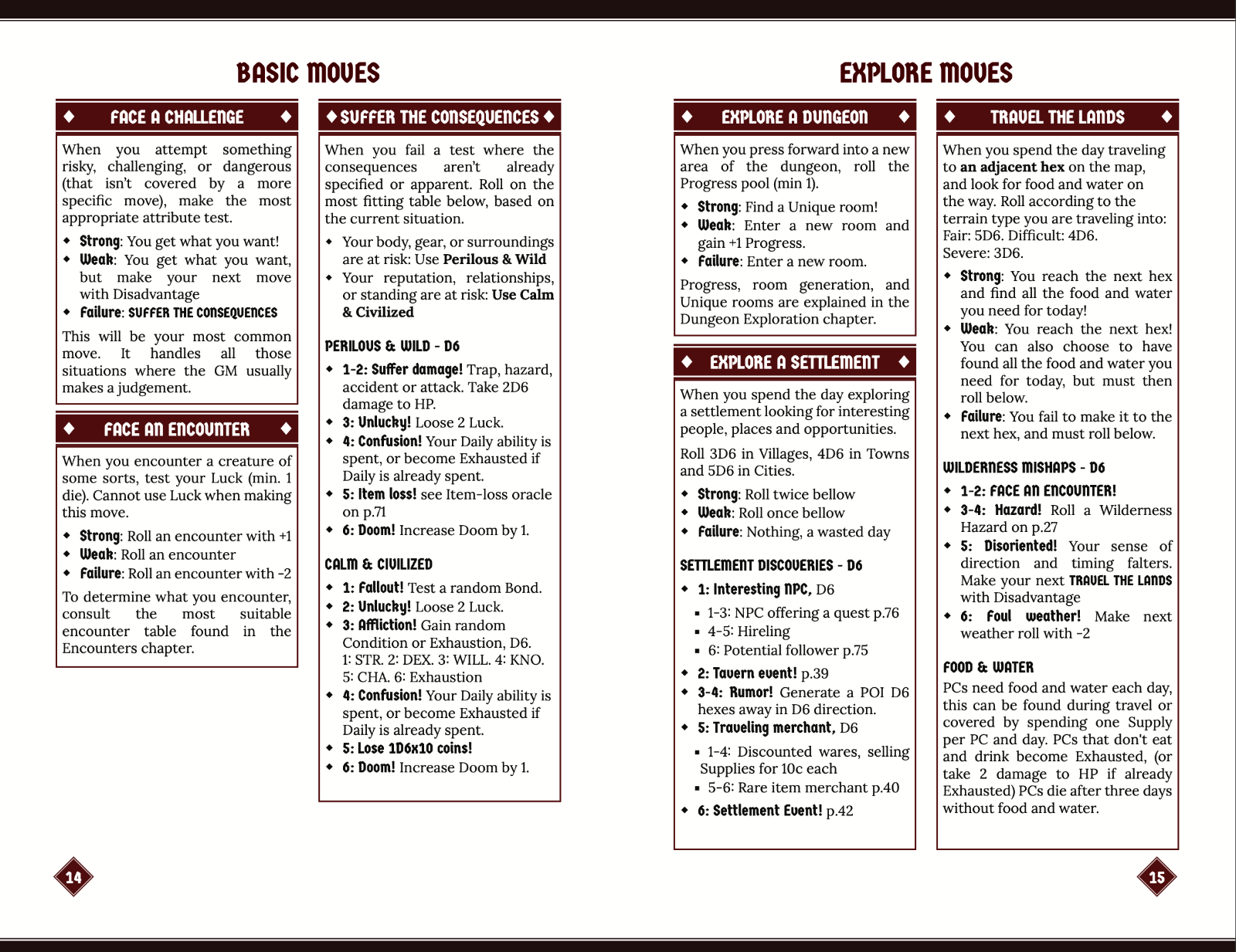
Many solo systems are built around Moves, clear triggers that tell you when to roll and what happens next. The image shows a few of the Moves from Undaunted.
How to solo play DnD with generic solo rules
If you want to play Old School Essentials (OSE), Mörk Borg or Adventurous without using dedicated solo rules you can use something like Mythic Game Master Emulator. A system that contains many random tables and various oracles to help you run your game.
Mythic frames play in scenes. When you roll for what should happen, results can trigger:
- Altered outcomes (a twist or complication)
- Interruptions or Random Events
These function sort of like consequences, but that aren’t mechanically specific, so they will often lead to new questions and eventually you as the player will have to decide what the consequences are. Personally, I think this way of playing is too vague. I can see the appeal in being able to play any game system solo, but one thing I want the central engine to do, is decide what the consequences are, and what complications I have to face. Those are critical aspects to make my solo sessions feel unpredictable, genuinely dangerous and exciting.
How to solo play DnD with dedicated solo rules
Dedicated rules are much more precise, since they are tailored to the game system they are built for. With dedicated rules there can be systems and procedures which have mechanical impact, such as relevant HP damage, item loss, social fallout and so on, since it’s all tied together.
Very few systems have dedicated solo rules, and not all of the ones that are available are robust enough to cover all of the above. A good example is the official solo rules for Shadowdark, which are basically just a list of recommended resources, paired with a Yes/No oracle.
Depending on the quality of the official solo rules, it can sometimes actually be better to use something like Mythic Game Master Emulator. This is why I designed Undaunted the way I did, it’s highly specific and robust, which creates fair and exciting sessions.
Solo play is a great way to enjoy the hobby when scheduling makes it difficult to get your regular group together, but you still feel that urge to explore a world!
Board and minis or theatre of the mind?
There’s no right or wrong here, but personally I prefer theatre of the mind. It is much less cumbersome, you can play anywhere, anytime. But if you enjoy minis, go ahead! It can add a lot of tactical detail and cool ‘look and feel’.
Key components in your solo play setup
Now let’s go through 9 things you definitely will need to run a smooth and interesting solo session. You can of course add many more things than these, but these are the critical components.
However, be careful with adding more resources, a very common issue in solo play is getting stuck trying to put together the “the perfect setup”, and never actually getting started played. Read more about that below.
1: A Yes/No oracle
This is your most frequently used tool.
Anytime you need to know if something is true or not, you ask the Yes/No oracle and roll.
- Is the door locked?
- Is anyone home?
- Is the bridge collapsed?
- Does the guard recognize me?
The oracle answers. You accept the answer and move on.
It can be as simple as a coin flip. Heads = yes, tails = no.
More advanced versions include probability shifts, such as:
Very likely
Likely
50/50
Unlikely
Very unlikely
Which modify what numbers count as a yes.
The exact implementation does not matter. What matters is that you are not deciding the answer yourself.
2: A Verb+Noun oracle
The Yes/No oracle answers questions. The Verb+Noun oracle creates ideas.
You roll once for a verb.
You roll once for a noun.
Combine them and interpret.
Examples:
- Corrupt + Priest
- Abandoned + Shrine
- Hunt + Traitor
- Protect + Child
- Burning + Village
This oracle is used when you need inspiration without authoring.
What is this NPC about?
What happened here?
What is the core of this problem?
Roll. Interpret. Move forward.
3: Dungeon exploration procedures
You will need a way to generate some kind of adventure sites, in a Sci-fi system that could be derelict space ship, and in a fantasy system that is of course the dungeons.
Assuming you want to play a fantasy system, which is the most common one, you’ll need a way to explore dungeons, preferably in a procedural manner, meaning creating them as you go, so that you have a chance to be surprised at what you discover.
4: Treasure generation
Without proper treasure or reward generation rules it will be very hard to have meaningful sessions. If it’s up to you as both the player and GM, everything will just feel arbitrary and flat. So you’ll want a way to generate treasure randomly, tailored to your specific system of choice.
5: NPC generators
You’ll run into many NPCs on your adventures, and coming up with them yourself won’t work. You’ll probably just get stuck trying. So make sure you have an NPC generator, and pair it with the Verb+Noun oracle if you need more context or information about an NPC.
6: Travel procedures
The three pillars of adventure are: Town play, Wilderness play and Dungeon play. So you’ll need procedures to handle all three, and wilderness travel is the last one this list.
This can be hexcrawling, pointcrawling or something else, whatever way you prefer to represent the world in, and traverse it. But you’ll need some way to make it interesting.
7: A way to run monsters
As you can imagine, it will be hard to play monsters in an unbiased way when you are both the GM and the player character on the receiving end of that Hobgoblin’s morningstar. So you’ll need a way to determine what the monsters do in combat, who they attack, if they use a spell and so on.
This can be done with something as simple as dice rolls. If the Hobgoblin has three targets to choose between, just roll a D3. If the enemy spellcaster has four spells to choose between, roll a D4, and so on.
Adventurous, which Undaunted is built for, uses a system where all NPC creatures has a list of random attacks they’ll make each turn. The same can be seen in Dragonbane, but that system only has tables for actual monsters, not all NPCs. The beauty of this system is that you’ll never have to think about what attack an enemy will make, you won’t have to worry about “playing fairly” and not cheating for the benefit of you PC. The system handles all that. If the troll chooses to pick you up and hurl you into the mountainside, then so be it, that’s what the dice decided.
Some systems include a “Combat tactics” table, where you can roll dice to see if they choose to take defensive action, use special attacks or use the terrain to their advantage. It’s a neat way of handling it, that usually works regardless of what game system you choose to play.
8: Time tracking
You’ll need a way to track time in a meaningful way. If it doesn’t matter if your journey across the Grey Marshes takes two days or five days, your game is lacking consequences.
This system should help you understand when a day is up, how many days a journey takes, how long you can stay in the dungeon and so on. It’s important.
9: Resource tracking
What these resources actually are can vary, it doesn’t have to be rations and gold, it can just as well be connections and fuel, or all four. But you will need a system or procedure that helps you keep track of resources, and for the system you play to provide you with relevant resources to track. Without it, your sessions will be arbitrary, and your choices won’t matter.
Make sure you choose a robust solo ruleset
All of the 9 critical components listed above are featured in most robust dedicated solo systems, such as Undaunted, Solitary Defilement or the Ironsworn core rules.
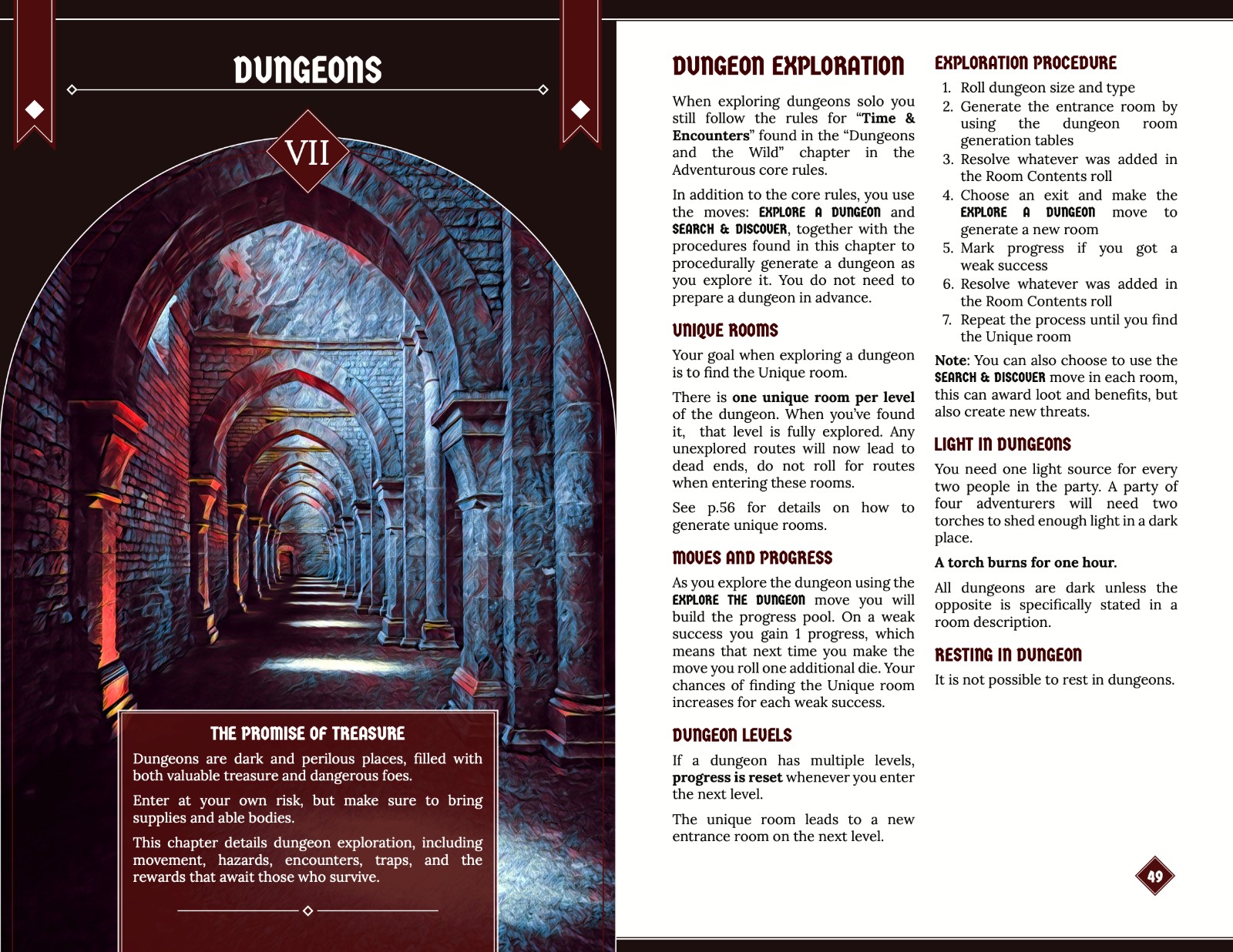
Undaunted features a robust but elegant dungeon exploration procedure that allows you to explore dungeons without having to do any prep.
Common solo play mistakes (and how to avoid them)
It might sound strange to include common mistakes when talking about a hobby that you do by yourself, for yourself.
But it’s not in the sense that you’re playing wrong by not speaking in first person or anything ridiculous like that. What I mean by mistakes is things players do that set them up for failure in one way or the other, things that will make it hard for you to either get started or continue beyond the first session.
Burnout due to too much note taking
I get the feeling, you want to document everything that happens, write out the full dialogue your PC has with the village elder, and so on. But don’t get stuck here.
My advice is to keep a journal of your solo campaign, but only write 3-4 short bullets for each day, and add a small drawing that’s significant for that day of play. It can be something as simple as a raincloud if that’s the weather you rolled that that, or a flower if you encountered a patch of flowers as you traveled the plains. You get point, a simple doodle and a few bullets, that’s all you need for solo notes.
Getting stuck trying to find the perfect setup
Way too common. You want to find that perfect wilderness procedure to port into your OSE solo game, currently consisting of 30% Mythic, 15% Shadowdark, and 20% Mouse Guard.
Remember this quote: “Done is better than perfect“. This certainly applies to putting together your solo kit. You are the only one playing with it, so if you don’t like something two sessions in, just replace it, it won’t affect anyone else. But be careful with discarding the built in mechanics in dedicated solo systems, they are there for a reason, and there is good chance that the designer tried three other version before settling on the one that’s in the book, simply because it’s what works best.
Playing with too many PCs
Another common issue I see on Reddit, and other forums, is games slowly becoming too complex and unwieldy due to adding to many PCs. In the beginning, at early levels, it might feel manageable. But as characters level up and grow they become more complex, and over time it becomes a chore to just get through a round of combat.
Solo play should be exciting and fast paced, that’s why most players actually play with one single PC, instead of a group.
Closing thoughts on how to play solo RPGs
Solo TTRPGs are not about pretending a GM exists.
They’re about building a system that acts like one.
With the right engine, the right procedures, and real consequences, you get a game that surprises you, pressures you, and occasionally murders your character.
That’s the good stuff.
This is a great hobby, a lot of fun. It can be a great way to satisfy that urge to play TTRPGs even when scheduling prevents you from getting the group together.
Solo RPGs can also be a fantastic way to explore spectacular worlds on your terms. Sometimes in group play, everyone doesn’t share the same vision for the game, and that’s fine, it would be absurd to ask everyone at the table to agree with your vision and play the specific way that you want. We are adults, sharing is key in life.
But in solo play you don’t have to be considerate, it’s totally fine to be more selfish and play exactly the way you want to play. If you want a tense game with a dark tone and visceral faction play, you can decide to play that way. If you want a lighthearted game that’s also fine, just play it that way. Ultimately, it’s up to you. You’re playing for your own enjoyment. Have fun with it!